
The Coal Region Roots (1880s to 1920s)
Long before pizza was an American obsession, Northeastern Pennsylvania was an immigrant frontier. By the 1880s, tens of thousands of Italians , most from the south, Sicily and Calabria and Abruzzo , had crossed an ocean to descend into the anthracite mines that powered the country.
They settled in tight-knit company towns: Old Forge, Pittston, Dunmore, Hazleton, Wilkes-Barre. They built churches, social clubs, and bakeries. The bakeries mattered most. In a region where men spent twelve hours a day underground, the Sunday loaf and the Friday bread were nonnegotiable rituals , and the brick ovens that produced them would, a generation later, produce the first pizzas.
The food culture they brought wasn't Neapolitan street food. It was rural, frugal, and built around the sheet pan: focaccia-like flatbreads with whatever was on hand , tomato, oil, sometimes anchovy. That sheet pan is the ghost in the machine of every NEPA tray sold today.
The Birth of the Tray (1920s to 1950s)
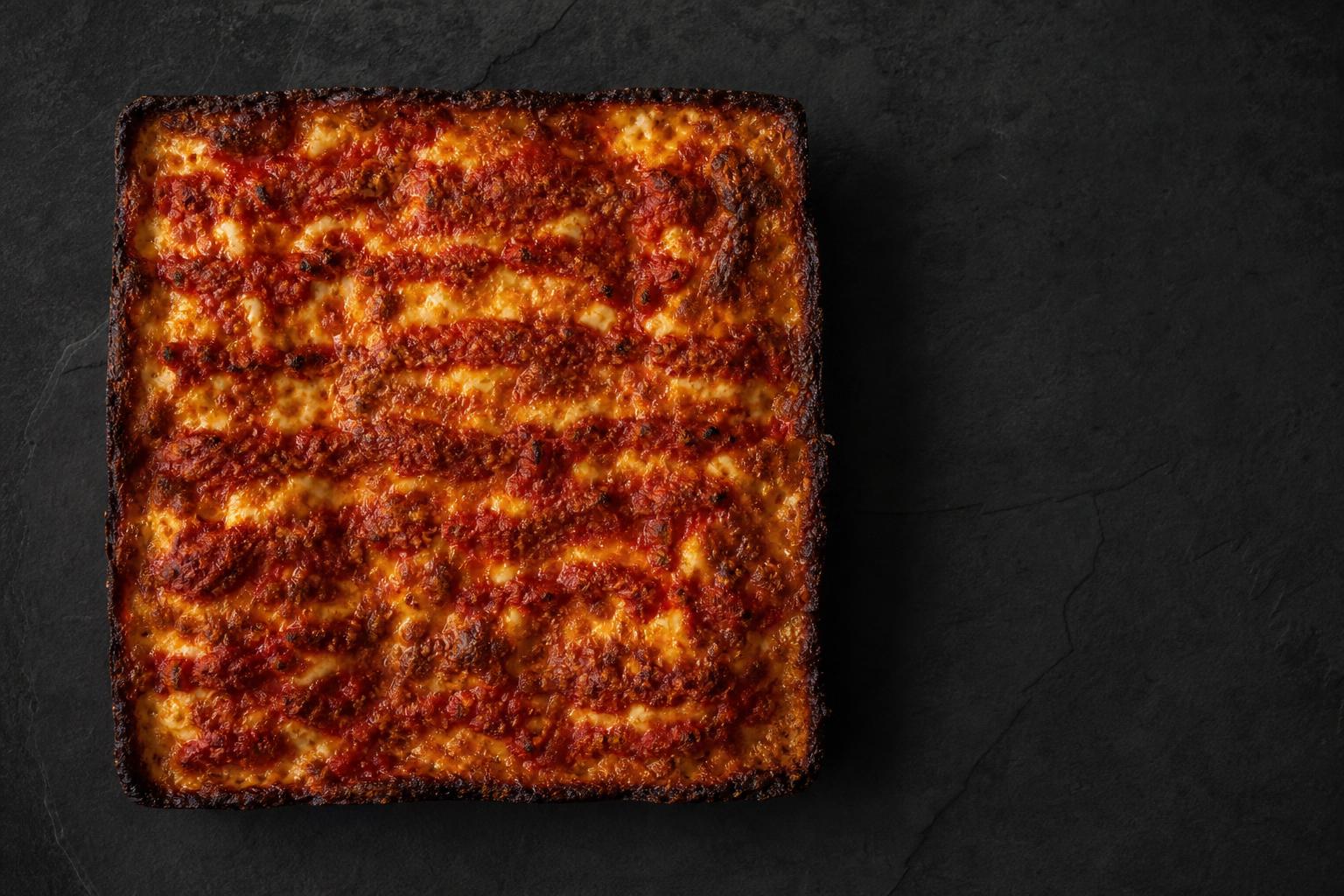
Ask anyone in Old Forge what they ate for dinner last Friday and they'll tell you they had "a tray." Not a pizza. A tray. The word matters.
Sometime in the 1920s and '30s, Italian-American bakeries in the coal region started selling rectangular sheet-pan pizza by the cut , first as a sideline, then as the main event. Ghigiarelli's in Old Forge is widely credited as the first to sell pizza commercially in the area, in 1936. The shape stuck because it was practical: easy to bake, easy to portion, easy to feed a hungry family or a shift of miners.
By the 1950s the rectangular tray had become the default. Round pizza existed; it was just considered an out-of-town format. The tray was ours.
Red vs. White: The Old Forge Divide
Old Forge runs on two trays. The "red" is what most outsiders expect: house-made tomato sauce, a blend of cheeses (often including American), a thick but tender crust with a slight char on the bottom. The "white" is the one that breaks brains: no sauce at all. Two crusts, top and bottom, stuffed with a soft cheese blend, often with thinly sliced onion and a hit of olive oil and oregano on the lid.
Revello's, Arcaro & Genell, Mary Lou's, Brutico's, Salerno's , every shop has its loyalists, and every loyalist will tell you their place does it best. They're all right, in a sense. The variations are real, and the differences are religious.
Red or white. Pick a side. There is no third option.
The South Valley Sweet Sauce Story
Drive twenty minutes south from Old Forge into Wilkes-Barre and the pizza changes character entirely. The crust gets thinner, the cheese gets blistered, and the sauce , the sauce , gets noticeably sweet.
Angelo's. Gerry's. Januzzi's. The South Valley sweet sauce isn't a marketing decision; it's a regional dialect. Some trace it to wartime sugar rationing reversing course in the late 1940s, when shops leaned into newly affordable sugar to round out cheaper canned tomatoes. Others swear it's a deliberate balance against high-acid Pennsylvania tomatoes. Either way, it's an acquired taste that locals will defend with their lives.
The Lakefront Empire: Grotto's Origin
In 1960, a former Pennsylvania state trooper named Frank "Tudie" Parente opened a small pizza shop on the shore of Harveys Lake. He called it Grotto Pizza. Over the next sixty years that one location would expand into more than two dozen restaurants across Pennsylvania, New Jersey, and Delaware.
The original Harveys Lake location is still there. It still matters. On a summer night, you can sit on the deck, look out at the water, and eat a pie that traces a direct line back to a single immigrant family's kitchen. Few American pizza chains can claim that kind of continuity.
The Modern Heritage Movement
The new generation of NEPA pizzaioli are doing something quietly remarkable: they're treating the regional tradition as a living thing rather than a museum piece. Tomato Bar in Pittston runs a wood-fired program that would hold its own in Brooklyn or Bologna. Sabatini's bottle shop has been a national wine destination for forty years. Pizza Perfect in Dallas has elevated the fried-crust style into something almost architectural.
None of it abandons the tray. All of it pushes the form forward. That's the trick , and that's what makes this moment in NEPA pizza worth experiencing in person.
Why It Matters Now
America has lost most of its truly regional pizza traditions. New Haven and Detroit and a handful of others survive in the national imagination. The rest have been steamrolled by chains, by gentrification, or by simple time.
NEPA still has it. The shops are still family-owned. The recipes still come from grandmothers. The arguments at the bar are still about red versus white and Angelo's versus Gerry's. It is one of the last living, breathing, contested regional pizza traditions in the country , and it deserves to be experienced firsthand, with someone who knows the back roads.
That's what we do.
To Reserve
Tour the story in person.
Ryan runs guided tours through every era of this tradition.
You've just gotta try it for yourself!
Most guests text first. Average response under fifteen minutes.